• Skip to main content

SUMMER LOTUS

My Blog

  • HOME
  • About Me
    • my blog and objectives
    • E-book on Singaporean cooking
    • E-book on water fountains in the home/ office

Uncategorized

Ways To Make Your Message Stick

February 13, 2022 by SUMMER LOTUS Leave a Comment

Uncovering gems to effective speech message from TED talks

2022, 7th February 7 min read

By Rosalind Ho using Canva.com

Communication skills have over the years powered up. When we watch presentations or speeches these days, we will realize that we get the ideas more succinctly and remember them longer.

There are so many aspects to effective communication skills including delivery, content, and language. I like to share my findings on how speakers make their contents stick. I shall list three ways gleaned mostly from watching TED talks.

1 Effective speaker use the multi-sensory experience

For the following reasons;

a) Powerpoints are no longer effective.

Remember the days when we were shown PowerPoint slides with bullet points to read?

By Rosalind Ho

It is found that a slide usually has as many as 40 words.

b) It is better to display an image and speak to the audience.

Research has shown that the audience can’t listen to the words and read the wordy slide at the same time. This is explained by the dual coding theory by Prof Paivio from Canada.

What is dual coding theory?

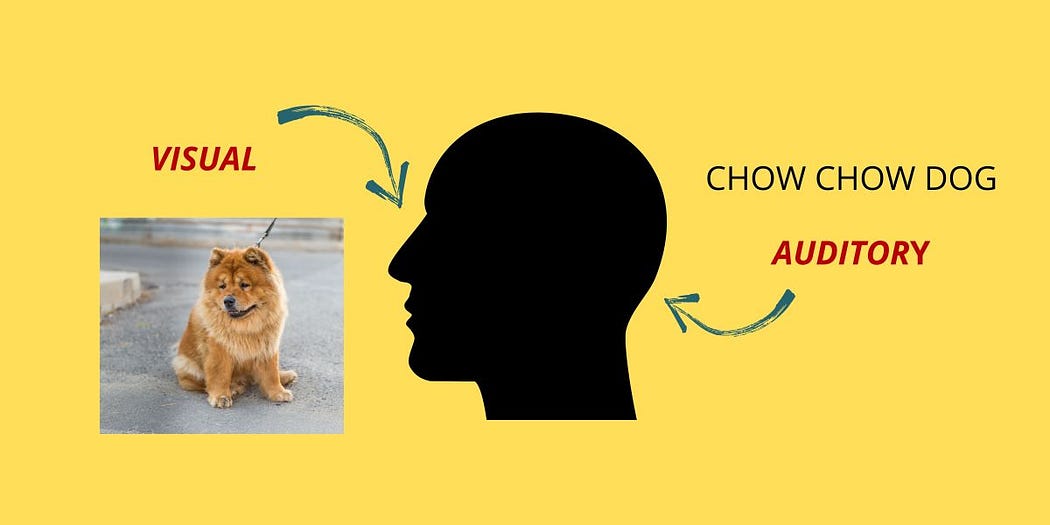
Prof Paivio explained that when you just give your audience a term or word, they will register it as a verbal code.

By Rosalind Ho

But when you give an image and a term, they will register it visually and verbally, making it a clearer concept.

By Rosalind Ho

Eg you mention a chow dog, we know it as a kind of dog

But when you attach an image of a chow dog, you will remember it as a very furry cute dog that looks like a bear.

Therefore, give your audience a double coding effect if you want the message to stick.

C) Neuroscience experiments have also proven the PSE (Picture superiority effect)

Evidence has shown;

A picture helps one to recall 6 X more than listening to words alone. If you hear information, you can only recall 10% 3 days later compared to a visual impact of 65%

By Rosalind Ho using Canva.com

The picture is now etched into your brain and will remain with you for some time to seek action.

Recommendation;

Visuals should enhance words, not duplicate — -TED Commandment

Use more images and even videos and narrate along with them. Appeal to the senses of visual, auditory, and touch if possible. Taste and smell may only be possible through narration.

— — — — — — –

2 Speakers use the rule of 3 — –

By Rosalind Ho using Canva.com

It has been discovered that 3 is the magic number of items or headings that people will remember in short-term memory. As the number increases, the retention reduces.

Under each heading, you elaborate and they could be further broken down into another 3 items.

The rule of 3 pervades our lives too;

In literature, we have 3 little pigs, 3 musketeers, 3 wishes granted to Aladdin.

In art, we have 3 primary colors — red, blue, and yellow

At the dinner table, you have 3 pieces of cutlery — spoon, fork, knife.

Steve Job’s 2005 Stanford Commencement Speech is a fine example that employs the Rule of 3.

He used a message map in 3 steps

By Rosalind Ho, adapted from the book “Talk like Ted”

First is the Headline

The headline is supported with 3 key messages

Under each key message, he had organized his storytelling into 3 points.

Steve Job’s talk can be viewed on Youtube.

It would be more effective if he had added more images and elaborated his rule of 3 speech. But that was back in 2005 when he spoke at the podium during his Stanford Commencement Speech and there were no visual aids used.

Forward to 2009 TED talk by Bill Gates Ted talk about “Mosquitoes, Malaria and Education” — nicely categorized under 3 headings, yet each category has poignant and relevant slides that drove the message home.

Bill Gates told the story simply. As the images were flashed, we see only relevant headings that did not clutter the images.

His statistical slides were also clean-cut and attractive.

He also used a short animated video to show the increased or decreased effect of an outcome.

3 Speakers use special techniques

1) Using Humor

Humor lowers defenses and makes the audience more receptive. The audience loves humor and if you package your message around it, it will be more impactful.

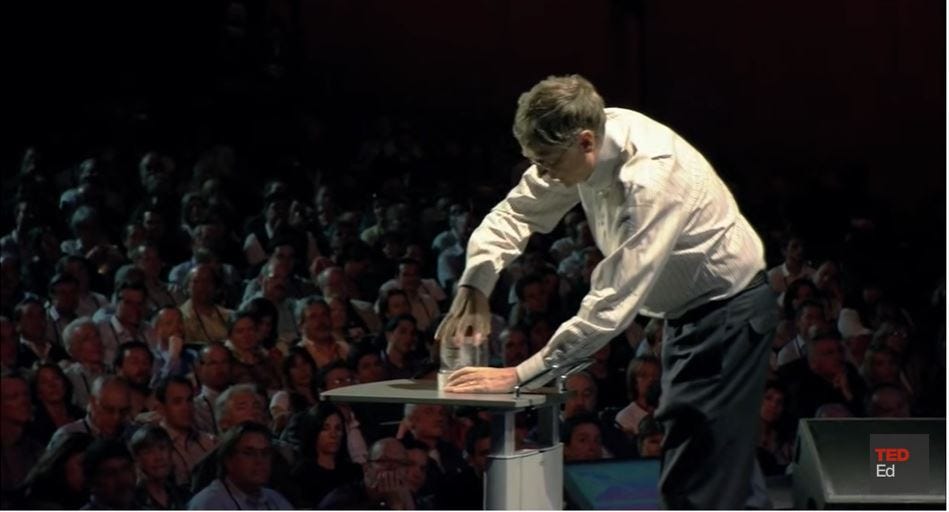
A good example is employed by Bill Gates in his TED talk about the elimination of mosquitoes worldwide. He mentioned that “there is more money put into baldness than malaria drugs. Baldness is a terrible thing and rich men are afflicted that’s why the priority has been sapped” — —This elicited a smile from the audience who found it amusing.

Print screen from Bill Gate’s TED talk on Youtube

He then opened the container to release some mosquitoes. He said, “ I brought these to let them roam around a bit; There is no reason why only poor people should have the experience” causing a burst of laughter. Meanwhile, behind him, an image of a mosquito drawing blood from the skin was displayed.

2) Using rhetorical devices like analogies and metaphors

An analogy is a clear comparison that something is like something to explain the situation better. You are comparing two different things that share similarities.

Eg Life is like a race

A metaphor is an implied comparison that something is something else with the same similarities.

Eg My baby brother is a cute little teddy bear.

These rhetorical devices are effective because they paint vivid imagery of the object or the situation that allows a clearer understanding in the audience’s minds.

They are also a more colorful and entertaining way of expressing the words making them more poetic, persuasive, and pronounced.

3) Using relevant quotes — -Motivational, inspirational, and realistic quotes by famous people help the audience develop a new perspective, enlighten them or shock them into reality. Many of these quotes are so wise that they continue to ring in the audience’s ears long after reciting them.

Examples;

The quality of your life depends on the quality of your thoughts — -Marcus Aurelius

Good communication is the bridge between confusion and clarity — Nat Turner

Quotes may be used in the beginning or in the conclusion to give additional impact to the message. Many times, a good quote has lingered in my mind so I know it can be effective.

In Summary, to make messages stick;

1. Use the multi-sensory experience of visual, auditory. Taste, smell, and touch where applicable

2. Deliver your message in a package of 3 headings.

3. Use special features like humor, rhetorical devices, and effective quotations.

May your speeches from now on be like a precious gift to your audience that they would forever cherish your message and carry out your appeal for action.

Filed Under: Uncategorized

Why, Oh Why Do I Let My Coffee Go Cold?

February 6, 2022 by SUMMER LOTUS Leave a Comment

A moment of reflection…..

Summer Lotus 2nd Feb 2022

By Rosalind Ho (Canva.com)

The coffee always came hot

But often, I consumed it cold

I watched, pondered, and thought

It was none other than my fault

Having a chat

Solving a spat

Mind asunder

To prevent a blunder

Failing to rest

When put to the test

Looking at news

As if one is on cue

Time flies

I suddenly realize

My $8 coffee has gone cold

Nonetheless, I gulped in one go

Another lovely moment misspent

It will not happen again, I quietly vent.

(Poetry from a restless soul)

Filed Under: Uncategorized

Winning With Your Organized Speech Content

January 31, 2022 by SUMMER LOTUS Leave a Comment

Make a speech that is clear to your audience

Summer Lotus Jan 23 4 min read

By Rosalind Ho (Canva.com)

Why are some speeches so memorable? Why does the message stick in our minds? Why do some speakers move you to take action?

The success of any presentation depends on three broad categories. They are delivery, speech content, and language.

According to Toastmasters International Speech Contest Judge’s Guide and Ballot, the scoring is as follows; content 50 percent, delivery 30 percent, and language 20 percent.

Content accounts for 50 out of 100 points possible on the judging ballot. Of those 50 points,

20 are dedicated to speech development (structure, organization, and support material)

15 to speech effectiveness (interest, reception, and achievement of purpose),

15 to speech value (ideas, originality, and logic).

Though we focus on the content here, the three categories are not mutually exclusive as they all contribute to an effectively communicated speech.

1 Speech development (structure, organization, and support material)

A speech should have a beginning, body, and conclusion.

The introduction opens the speech with an attention grabber. It can be a quotation, a visual aid, a dramatic opening, a story to set the background for the latter part of the speech, etc.

A good speaker may use it to comment about his topic, put across his objectives clearly, establish his credentials, and /or get acquainted with his audience by asking questions.

This should not be lengthy as the audience expects the speaker to launch into the speech soon. Moreover, the attention span of the listeners is limited.

The introduction for a speech should take about 10 to 15% of the entire speech time. This means if the speaker expects to talk for about 5 minutes, his introduction should be no more than 45 seconds.

The key is to rein in their attention immediately and garner their interest.

The body of the speech is the meat of the whole delectable meal which is the presentation. This is where speech organization is important.

In a contest speech that is usually 7 minutes, there should be about 3 main points (max 4) to make them memorable. Each point should have a clear and concise story that should be backed up with evidence, an anecdote, statistics, or a survey.

The points are listed as 1, 2, and 3 to make each part succinct. Under each point, the speaker would narrate in detail with an anecdote that could be based on your own story, an observation, other people’s experiences. From one idea to the next, there should be a pause to allow the message to sink into the audience’s minds.

This pause can be made effective by using words like “In addition..”, “ Moreover..”, “ Furthermore..”, etc to ensure a smooth transition of the narrative.

When making the next point, the speaker should have a clear transition like a signpost. The speaker could say, “ The next point is…” or “ My number 2 point is….” The audience is guided to be aware that the first main point has been elaborated and should be ready to listen to the second main point.

If the next point is final, the speaker could announce it as, “My final point is..” or “The third and last point is…”, etc

The main points would clearly guide the audience to a clear understanding of the story that supports the speaker’s theme and objectives of his speech. The audience knows that the presentation is about to end and awaits a conclusion.

In the conclusion, the speaker may summarize the points mentioned briefly and make a strong appeal for action. It is important for the speaker to tie the speech to his objectives so that the audience leaves with a strong message and is persuaded to carry out a worthy cause.

A conclusion should be about 5% of the total speech length. Anything less means that the speaker has ended the speech abruptly and is likely to lose the impact of his or her message.

Too long a conclusion will leave the audience restless and going of a tangent to start a new point is definitely not good.

2. Speech effectiveness (Interest, reception, and achievement of the purpose)

The speaker should carefully select a topic that is of interest to the audience after finding out their demographic, interests, and background. Ask yourself;

Is the topic current? — A topic that involves most of us and that we can resolve by participating would generate interest.

Is the topic taboo? — Issues on race, politics, religion and some sensitive social issues should not be in your department as a commoner.

Is resolution possible — People would like to know if they can be in control of a situation so a topic that is outside their means to resolve would hardly be useful.

3 Speech value (ideas, originality, and logic)

The speaker should choose a topic that provides value to the listener in the respect that they received a better insight into a situation, are enlightened and hopefully motivated to carry out an action that benefits others as well.

Speech that scores are the ones that are original and not plagiarized from any books or articles on the internet. It should preferably be novel in its ideas or concepts. Having humor has a great plus point as people love a good laugh. The speech should also have a logical flow of narration without any preposterous suggestions or theories.

Finally, in addition to Speech content, if the speaker works equally well on the category of delivery as well as language use, the result would certainly be a winning speech in the contest.

Filed Under: Uncategorized

To Embrace Change, Change Yourself

January 23, 2022 by SUMMER LOTUS Leave a Comment

Summer Lotus Jan 9th 2022 4 min read

Stay resolute to be adaptable to change.

By Rosalind Ho (Canva.com)

Is it the pandemic or just a sign of the times? Everything is in flux.

It keeps you running on a treadmill. Life has always been that way, it is just that we were not aware. Think back to your younger days — -you had fears, you did not have certain skills, you did not foresee certain events — but now you have evolved. Because you have changed with the times. Thoughts and surroundings have changed and will continue to do so.

Nothing is permanent except change. Nothing stays status quo except the human mind if it refuses to grow along with changes that are unavoidable. If you remain resolute to stay adaptable and positive, you will roll with the punches of life and find it an exciting journey.

The human body is changing every minute. Cells die, new cells are created, maybe at a slower pace. In my clinic, some patients asked me why did teeth relapse after braces? The teeth and gums and the bone condition are different as we age. As a dentist, we see oral conditions change relative to a patient’s health, habits, and personal care.

Why did teeth move even after braces? That is because inflammation may occur in the mouth resulting in bone loss and reduced tooth stability is just one of the common reasons. How does one deal with this change? The retainer is made to keep the straightened teeth in position. Eventually wearing them half-time could help.

Look at the innumerable products on the shelves today. They have more designs, functions, tastes, etc. Humans are evolving all the time as we are a progressive species. We enjoy a better living standard because there are people who make changes to benefit others.

“Progress is impossible without change and those who cannot change their minds cannot change anything” — -George Bernard Shaw

The pandemic is a good case in point. As the virus presents itself in new forms, humans work on various vaccines and ways to defeat it. The pandemic wreaks havoc and countries have imposed restrictions and innovative ways to contain the spread of the virus that has been changing with the infection status.

Work and learning continue as we move online. We digitalize and robotize to carry on improving our standard of living.

Change is omnipresent. There is no point in whining about it and how we have to continuously find ways to cope with it. We should cope with it!

Times change. What works yesterday may not work tomorrow. Look at the number of modes of payment today. With more payments done through apps, who would have thought that you do not need to bring your wallet out anymore? You can pay for your purchases, food, and bills using the magnificent device called the smartphone. I see it as an absolute convenience.

Daddy and mummy do not know best anymore. If you have any queries, Google can be your adviser.

However, some things do not change, like habits such as being lazy, indifferent, and tardy. If you do like to see change and adapt to it, you will be left by the wayside. Everyone is swept along this mainstream of transformation and is struggling to deal with it and would not have time to help you out. You either conform, adapt or fizzle out and be confounded by change. No one will sympathize with you because everybody else is busy trying to cope.

Realize this fact and change yourself;

1 Accept that Change is eternal. People get smarter because they innovate and adapt. The world is getting more sophisticated whether you like it or not. One might as well dive into change and enjoy the ride.

2 Be curious. Start asking questions and seek out helpful friends who are patient enough to enlighten and empower you with the knowledge to cope with changing norms of daily living. You should seek out a wider social circle. An additional friend could be an avenue to new knowledge if you choose your friends carefully.

3 Be determined. Continuous learning is key. The world is your oyster especially if you are connected to the internet. You could pick up any skills that interest you and develop them. Almost every solution can be found on the internet though you would have to sieve the wheat from the chaff so to speak where real and fake information is concerned.

Finally, be certain that changing yourself will bring pain as you set out to learn new things. Being out of the comfort zone is naturally disturbing. The learning curve seems steep but every step taken will make you wiser and happier.

Stay resolute to be adaptable to change and embrace it.

“The secret of change is to focus all of your energy not on fighting the old but on building the new” — -Socrates

Filed Under: Uncategorized

How To Get Hold Of Your Emotions

January 1, 2022 by SUMMER LOTUS Leave a Comment

Start off the year with this skill….

Summer Lotus 1st Jan 2022 4 min read

Photo by Hello I’m Nik on Unsplash

We are complex human beings, affected by the emotions of peace, joy, anger, jealousy, anxiety, greed, gluttony, fear, sadness, lust, shock, pride, sloth, grief, etc.

It is these emotions that motivate us into action or slow us in our tracks.

It is these feelings alone that persuades us to do something much more than rational thinking.

It is these feelings that can help you succeed or fail you in your attempts.

It was exactly negative feelings that impeded my progress from a young age. Innately introverted and introspective, I would always stay on the sidelines, observing, wishing, hoping, dreaming….

To become a better student, a successful career lady, a good mother, an efficient wife. It was all about the actions that I needed to take but my overriding emotion was anxiety and fear. In particular, the fear of public speaking. They impeded the growth of my personality.

The fear of speaking up was the bane of my life. I had no clue as to how to make myself heard which was a big stumbling block to personal progress.

Mediocrity was the order of the day. The non-eventful student days went on monotonously for years as I watched how some of my friends were so brave and eloquent and attained their goals.

Naturally, people who made their requests heard, had something to show, got what they want. It was no surprise that I emerged as an also-ran, still wading through the waters of young adult life, muddled and aimless. But, there was always an inner voice sounding me, “You need to come out of your shell and be heard”.

For years on, I searched for ways to learn to speak up and be heard. I dabbled in public speaking courses such as enrolling with the BBC for a hefty fee which was a shocker to me when they taped us speaking. It left me completely non-plussed.

Then, I joined the Dale Carnegie course and was poorer by more than a thousand dollars for ten sessions. However, it was an ice-breaker for me and I improved somewhat. The improvement came after five projects of speaking but I wished that I had more drive for excellence.

Next, I discovered Toastmasters International, a public speaking movement that was started by Mr. Ralph Smedley in the US and had since evolved into innumerable clubs in many countries. My depth of participation fluctuated but after many years, I would like to credit my progress to the program run by the club.

The change is insidious. I do not get stumped by questions these days and am able to give a positive spin to most questions. How did I overcome my anxiety over public speaking? Looking back on the journey, it was obvious. Persist and look for more opportunities to speak. Do your projects seriously.

The starting points were always very painful as they involved hard work, fear of failure, embarrassment even ridicule. The truth is, most people are busy with their own anxieties and insecurities to be bothered by yours. Hence, the anxiety was my own illusion.

Most of us are not born speakers but we can hone ourselves into good speakers. Through learning, training, and practicing. My anxious mindset was my own making.

Over the years, I find that most problems are quite minuscule if we first overcome the fear and worry caused by the problems and instead focus on the solutions. Worry causes you to go around in circles and closes your mind. When you tame the beast that is anxiety, your brain will gravitate towards solutions and a more positive outcome.

The same principle applies to the gamut of emotions listed above. When angry, hold back as nothing good comes out of anger. Anger may lead to an impulse to defend, which may not be the right thing to do if you are wrong. The correct thing is to admit and apologize.

Anger may lead to the impulse to leap at the other party which is equally unwise and have dire consequences.

“In anger, we should refrain from both speech and action” — by Pythagoras. After simmering down, the whole incident may be a non-incident at all. One may even laugh at one’s folly. In any case, disasters are averted.

In any case, one may ask ourselves; What am I feeling? Why? What happened? How did it happen? What could be done about it? What are the possible consequences of an unbridled emotion? Will I regret it later?

The only emotions worth cultivating are joy and peace.

Filed Under: Uncategorized

Skills I Need To Master To Succeed At Work.

January 1, 2022 by SUMMER LOTUS Leave a Comment

Summer Lotus Dec 28th 2021 4 min read

Life can be smooth sailing…

From Canva.com

I wake up every day and somehow there are new mountains to climb. You need to get stuff done but your schedule is packed for the day. Once you stepped into the office, you are barraged by a hundred questions from staff. There are some hiccups in the office protocol/schedule that may dismay the customers.

Welcome to life, at home or in the office. Unless you live as a hermit, away from the din of city life, have few friends, and do not interact with most people, you would face less stress but you may also be consumed by boredom. I choose the former because it is not only challenging, it puts my wits to the test and there is a sense of fulfillment when things get done.

What you need are loads of patience, calm, communication, and determination.

Patience because things can be sorted out. Everything takes time as you strategize, leveraging on experience, connections, and timing.

Calm because the mind is a powerful instrument. It is an abyss of ideas but they are only released when the temperament is good which stills your heart and your knee-jerk reflexes and your negative emotions.

Communication because it is key to the solutions. People are not mind-readers but when there is a clear discourse, there are very few unreasonable people. In fact, they may stand on your side as they want to see you to succeed!

Determination because you will fail before you finally succeed. And fail many times. Obstacles seem insurmountable but eventually, they will diminish and you will stand on the pinnacle of victory. Even if you don’t, your lessons learned will enable your next challenge to be easily overcome.

One example; the bookings for the patients were messed up one morning. Suddenly, you have three ongoing appointments seeking treatment and all in the waiting room. Usually, patients have to get back to work or have another appointment outside.

State of calm activated. I seated the most elderly first ( the rest of the patients would understand) then listen out to his complaints. After reassuring him and telling him what would be done, I requested that he wait for me as it takes time to solve his problem efficiently. Effective Communication always works and one case is put on hold.

The second patient is attended to. The problem of most concern is attended to. Diagnostic work like X-rays is carried out. Clear explanations are explained and the patient is given a pain-killer if in pain and that itself takes time to come into effect. If not, the third patient waiting outside would be informed of the extra waiting time while resolving this case.

The third patient is attended to. Definitive work can be done like general work such as prophylaxis or restoration that usually do not take up much time. If there is extensive dental work to be done, the patient is explained about the complexity of the situation and re-appointed. Patients are very understanding. Discharged happily.

The first two patients are then treated consecutively and discharged. In my younger, inexperienced days which I noticed in younger colleagues of mine today, there is always a state of panic as to where to start.

Calm and communication in this instance solved the hiccups. Without calm, you may bungle up on your diagnosis as the mind needs to process the findings accurately. Without communication, your patients would become flustered and storm out, thinking that your clinic is disorganized. Of course, an apology to each patient is in order.

The second example; patient called and complained about an unsatisfactory treatment — Filling has dislodged again. From experience, I knew it was not the same one done. Most patients are not aware of exactly which tooth was treated but only could point to the quadrant where the treatment was done.

With the use of the dental camera and digital treatment records, we were able to show that the new restoration is done was still intact and the dislodged filling is often the next tooth. This has happened a few times. The patient had flared up unnecessarily.

Listen out to the patient patiently, instill calm by being composed yourself, and communicate with the patient with evidence provided, and have the determination to ensure that the patient has a pleasant experience that would lead to a successful outcome and repeat business.

This strategy applies to everything else outside work. In all situations involving misunderstandings, unhappiness, accusations, the greatest skill to master is calm. Followed by the patience to explain and the communication skills to put your points succinctly across. Determine to unravel the perceived problem and you will meet with success.

Filed Under: Uncategorized

  • « Go to Previous Page
  • Page 1
  • Interim pages omitted …
  • Page 7
  • Page 8
  • Page 9
  • Page 10
  • Page 11
  • Interim pages omitted …
  • Page 37
  • Go to Next Page »

All rights reserved by Summer Lotus 2020

This website uses cookies to improve your experience. You may opt-out if you wish. PRIVACY & COOKIE POLICY, TERMS & CONDITIONS
Cookie settingsACCEPT REJECT
Privacy & Cookies Policy

Privacy Overview

This website uses cookies to improve your experience while you navigate through the website. Out of these cookies, the cookies that are categorized as necessary are stored on your browser as they are essential for the working of basic functionalities of the website. We also use third-party cookies that help us analyze and understand how you use this website. These cookies will be stored in your browser only with your consent. You also have the option to opt-out of these cookies. But opting out of some of these cookies may have an effect on your browsing experience.
Necessary
Always Enabled
Necessary cookies are absolutely essential for the website to function properly. This category only includes cookies that ensures basic functionalities and security features of the website. These cookies do not store any personal information.
Non-necessary
Any cookies that may not be particularly necessary for the website to function and is used specifically to collect user personal data via analytics, ads, other embedded contents are termed as non-necessary cookies. It is mandatory to procure user consent prior to running these cookies on your website.
SAVE & ACCEPT